Wine-grape area · 2015
About 3,000 haA historical industry figure attributed to Ksara oenologist Elie Maamari in the organiser’s account of his talk on 24 March 2015. Not a current land survey.
Home / Viticulture
From the coast near Batroun to the high Bekaa Valley, Lebanon’s vineyards have different starting points. Explore the landscapes, grapes and decisions behind the wines.
Explore the wine regionsA landscape worth understanding
Lebanon’s vineyards can bring ripe fruit and freshness into the same glass. To understand that balance, look beyond a single altitude or soil description.
A short journey inland crosses coast, mountain slopes and the high Bekaa plain. Yet neighbouring vineyards can respond differently to sun, wind and water. Growers work with those conditions through their choice of grapes, canopy management and harvest timing. This guide connects the landscape with the decisions made in it, using dated figures and specific vineyard examples rather than a single national formula.
In figures
Figures become useful when their date, unit and subject stay attached. A count of wineries answers a different question from the area planted with vines.
Wine-grape area · 2015
About 3,000 haA historical industry figure attributed to Ksara oenologist Elie Maamari in the organiser’s account of his talk on 24 March 2015. Not a current land survey.
Production estimate · 2024
10–13 millionBottles a year, according to INVV president Zafer Chaoui’s estimate in an interview published on 21 March 2024. An attributed estimate, not a bottle count.
Wineries · OIV 2018
Nearly 50The OIV’s report of 23 September 2018 described producers. It did not count individual vineyards or establish today’s total.
A vineyard example · IXSIR
1,800 mAinata illustrates the heights reached by a particular estate’s vineyards. It is not presented here as a national altitude record.
A national vineyard-area figure may include grapes for eating, drying or distilling. The BESTMEDGRAPE report cites 9,122 hectares of vines and 100,000 hectolitres of wine for 2016 from OIV data. Its Lebanon contribution dated September 2020 describes about 54 wineries. Those different measures and dates should remain separate when comparing the sector’s scale.
One winery may work several sites or buy grapes from independent growers. In 2024, the national vine and wine institute discussed a survey of wine-grape land and acknowledged gaps in the data. Our winery directory is an editorial selection, so its number of profiles cannot stand in for a complete national register.
Regions & altitude
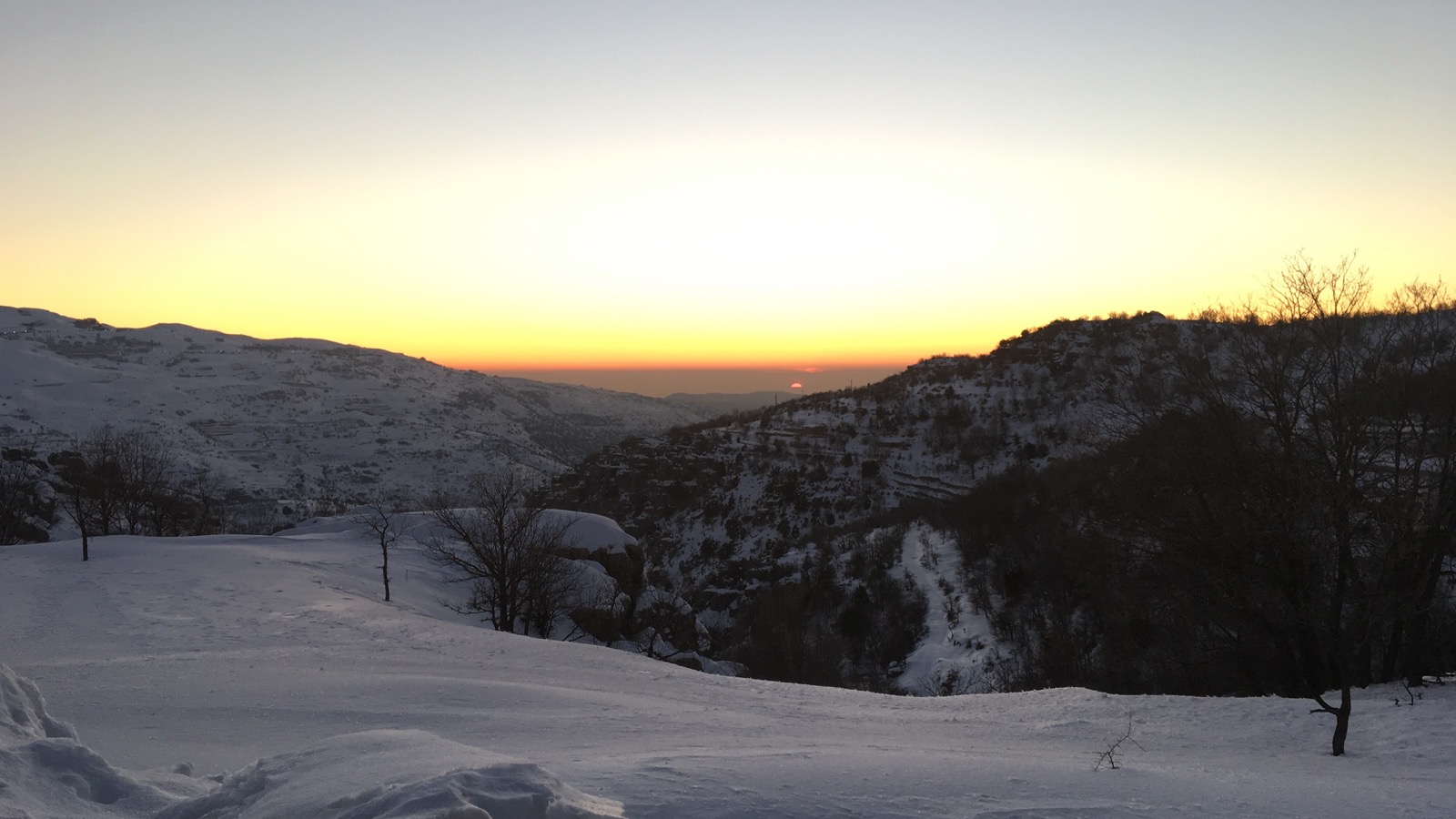
Mount Lebanon separates the Mediterranean coast from the Bekaa. Beyond that high plain, the Anti-Lebanon range forms the eastern horizon.
Maritime air meets coastal vineyards and the foothills behind them.
Slopes, exposure and the rain shadow create contrasting conditions.
Vineyards lie between two mountain ranges, often already at considerable elevation.
The eastern mountain chain follows the border with Syria.
The name Bekaa Valley can suggest a low river landscape, but many vines already grow well above sea level. The mountains influence rainfall and airflow without sealing the plain off from surrounding air. A study of two Bekaa sites used Taanayel at 800 metres and Kanafar at 1,020 metres, showing why individual locations matter.
Batroun, Mount Lebanon and Jezzine bring coastal slopes and southern uplands into the picture. The place where the grapes grow matters more than the address of the cellar alone. An estate may source fruit from several regions, while its sites differ in exposure, elevation and the varieties that can ripen there.
IXSIR’s vineyard descriptions offer concrete examples of that variation. The soils and grapes below are producer-reported details for selected sites, rather than a national classification.
On a small screen, scroll sideways within the table to compare all four columns.
| Vineyard site | Elevation | Soil reported by the producer | Example grapes |
|---|---|---|---|
| Basbina / Batroun | 400 m | Clay, sand and limestone | Syrah, Mourvèdre, Petit Verdot |
| Jezzine | 950 m | Calcareous clay and fractured limestone | Syrah |
| Deir el Ahmar | 1000 m | Gravelly, iron-rich calcareous clay | Cabernet Sauvignon, Tempranillo |
| Kab Elias | 1100 m | Clay with limestone | Merlot, Chardonnay, Sauvignon |
| Niha | 1200 m | Calcareous marl | Viognier |
| Ainata | 1800 m | Shell-bearing limestone with clay | Syrah, Cabernet Sauvignon, Caladoc |
Microclimates
Elevation, slope direction, wind and distance from the sea work together. Their effects also change with the weather of a particular growing season.
Sunlight supports sugar development and ripening, while cooler nights can slow the loss of acidity. Massaya describes possible summer temperatures of 40°C by day and 18°C at night. These are the estate’s illustrative figures, not a national daily average. Variety, crop condition and the eventual picking date still help determine the style.
Moist Mediterranean air reaches Mount Lebanon before the Bekaa. Massaya gives approximate rainfall figures of 1,300 mm for Mount Lebanon, 650 mm for the central Bekaa and 250 mm for Ras Baalbek. The producer supplies no climatological reference period for these values. They illustrate spatial contrasts, rather than the rainfall of a particular vintage.
Airflow can help wet leaves and bunches dry, but an exposed site may also lose water more quickly. Growers balance ventilation with protection from intense sun. The conditions around the bunches depend on canopy structure as well as regional weather; a single wind effect is too simple an explanation for an entire valley.
Higher sites can develop differently from warmer vineyards below, yet frost and a shorter growing season may limit what ripens reliably. The Bekaa study covering 2006–2018 links weather with yield and grape composition. It supports attention to vintage and site, rather than a rule that greater altitude automatically produces better wine.
Soils
Soil influences roots, water and nutrition. Understanding those functions is more useful than assigning a finished flavour to the name of a rock.
Loam is a mixture of sand, silt and clay; clay is the particularly fine fraction. Clay-rich ground may retain substantial water, but pore structure, compaction and root development affect what a vine can use. Stored winter moisture can be valuable in summer, while poorly structured heavy soil may hold excess water or restrict aeration.
Marl combines carbonate-rich and clay-rich material. Fractures in underlying rock may offer routes for roots, while soil depth affects the volume available for water storage. Slope, surface stones and vineyard management also influence runoff and temperature. The label “limestone soil” alone therefore cannot establish how a vineyard drains or predict the wine’s style.
Viognier has its own aromatic potential, including floral and stone-fruit characters. Ripeness, aroma compounds and their precursors, and winemaking decisions shape what reaches the glass. A suitable site and water supply can support that potential, but saying that Lebanese clay creates peach would overlook the grape itself. Viognier can also produce generous texture and considerable character.
Wine Australia: Viognier Wine Australia: Viognier research report
Water
The timing and storage of water matter alongside the total rainfall. Different vineyards draw on different combinations of rain, soil reserves and supplementary irrigation.
Melting snow can feed streams and springs or infiltrate underground stores. Geology and flow paths determine which areas benefit; a vine does not necessarily receive meltwater directly from the nearest summit. Bekaa groundwater research published in 2011 used samples from 2003–2004. A 2014 snow-cover study analysed MODIS observations from 2000–2012. Neither establishes three months of snow at every vineyard.
Bekaa groundwater study, 2011 Study of snow cover in Lebanon’s mountains, 2014
Rain-fed vines use rainfall and water held in the soil without additional irrigation. Whether that is sufficient depends on roots, vine age, soil and the season. Research on agricultural water use in the upper Litani basin describes different practices alongside one another. A single irrigation method cannot be assigned to all vineyards in Lebanon.
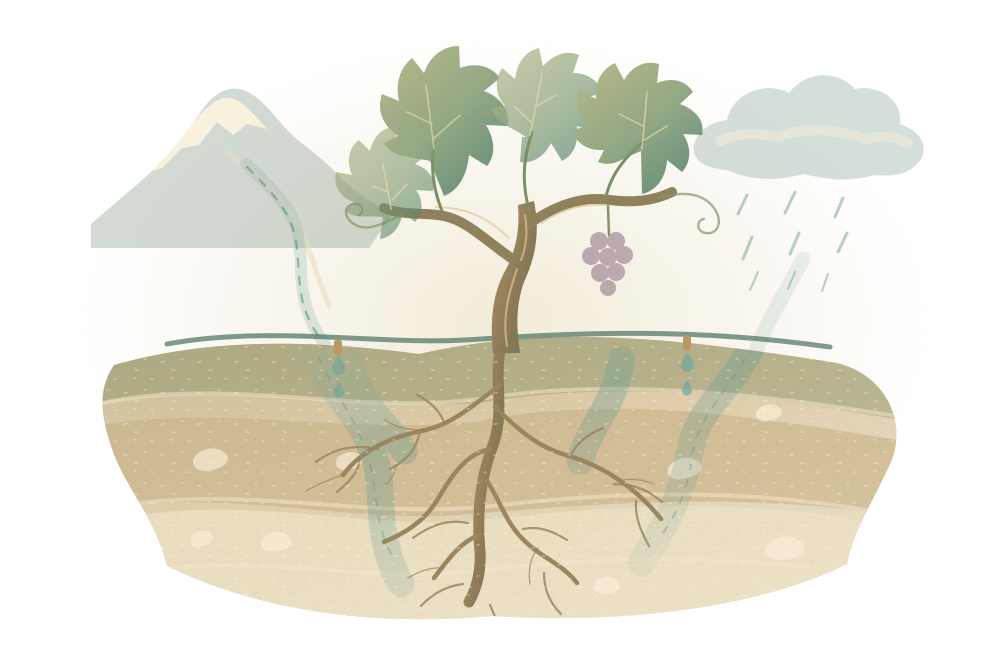
Where drip irrigation is used, pipes carry water to emitters close to the vines. Filters, pressure and flow need to suit the installation. Scheduling considers soil moisture, weather, plant condition and growth stage. This explains a method, rather than how widely it is used nationally, and it gives no universal weekly litres-per-vine prescription.
Limited water can restrain shoot growth, while severe stress can impair photosynthesis and ripening. Young vines with small root systems differ from established, deep-rooted plants. Regulated deficit irrigation deliberately adjusts timing and quantity, using measurements and observation. Variety, soil and intended wine style influence whether that approach suits a particular vineyard.
Grape varieties
International varieties appear throughout the wine range. Local grapes add further possibilities, with several names and spellings worth recognising on a label.
Also written Obeidy or Obaidi, this traditional white grape belongs to Lebanon’s wine and grape-distilling culture. Different transliterations can obscure a familiar name when comparing labels. The OIV highlights it among rediscovered local varieties. Read the individual wine’s composition to see how the producer uses it, on its own or in a blend.
Merwah appears in single-varietal wines and blends, alongside Obeideh in discussions of local white grapes. Its identity should not be reduced to an assumed equivalence with Chardonnay or Sémillon. An ancestry claim needs clear genetic evidence. For the drinker, the producer’s account of the vines and the actual wine provides a better starting point.
OIV: Lebanon’s vitivinicultural sector, 2018 Wine from Lebanon: grape-variety material, 2023
This red grape has coloured flesh, making it a teinturier variety. Château Cana gives it a visible role in its single-varietal Jardin Secret red wine. The wine documents use Sabbaghieh or Sobbaghieh, rather than Sabrayeh. It is a useful reminder that local grape heritage includes red varieties as well as the better-known white names.
This local white grape broadens the picture further. Wine from Lebanon’s variety material mentions a single-varietal interpretation by Karam Wines. Such examples invite discovery beyond the two most frequently discussed local white grapes. As with any less familiar name, check the spelling and composition on the particular wine rather than assuming all local varieties share one style.
Cabernet Sauvignon is described as Lebanon’s most widely planted variety in the 2024 Bekaa study. Cinsault and Carignan have a long history in the country, while Syrah, Merlot, Grenache, Mourvèdre and Petit Verdot also appear in producer accounts. This is an orientation, not a current percentage ranking. Blends bring together grapes with different ripening patterns and structures.
Ghantous et al., Scientific Reports, 2024 Château Musar: heritage and winemaking
Chardonnay, Sauvignon Blanc, Viognier, Sémillon and Muscat also form part of the range. Matching variety, site and picking date creates different expressions, rather than one national white-wine aroma. Château Musar, meanwhile, is an estate name, not a grape variety. Its name on a bottle points to the producer; the wine’s own information gives its composition.
In the vineyard
Climate can make some tasks easier, but healthy grapes depend on observation and timely decisions throughout the growing season.
A dry canopy can reduce conditions favourable to some fungal diseases. Powdery mildew, however, can infect without free water on the plant surface, so a cold winter or a dry summer does not replace monitoring. Organic production also does not mean that crop protection never occurs. Claims about a wine’s farming method need producer-specific evidence.
Leaves supply the plant and help shade bunches. Shoot positioning, leaf removal and crop management need to preserve airflow without exposing berries to damaging heat. Snow reflects light, but a significant summer lighting benefit across the whole Bekaa from distant snowy mountains is not established here. Direct exposure, slope direction and canopy architecture provide firmer explanations.
Sugar concentration is only one part of ripeness. Growers also consider acidity, berry condition, aroma and, for reds, tannin development. Varieties and plots do not necessarily ripen together, while earlier and later picking can serve different styles. Comparing vintages can reveal how weather and the grower’s decisions interact without suggesting one ideal national harvest date.
Hectares describe land, tonnes describe grapes and hectolitres describe wine volume. Area alone cannot establish bottle production without yield information. Musar reports a maximum of 30–35 hectolitres per hectare for its established red-wine vines. That is a particular estate’s figure, not Lebanon’s average, and low yield by itself does not prove higher quality.
In the glass
A place becomes easier to understand when you can compare actual wines. Use the producer’s details to ask more precise questions about what you taste.
Compare two wines of the same variety and note acidity, fruit ripeness, the impression of alcohol and texture. Similar vintages and ageing methods make the discussion easier, although several factors will still differ. A side-by-side tasting is an exploration of possible influences, not a controlled scientific demonstration that altitude or soil caused one particular flavour.
A local white beside Chardonnay or Viognier opens another discussion. Which aromas suggest the grape, and which may relate to maturation or cellar choices? For a restaurant or wine shop, those concrete observations support a more useful recommendation than giving every Lebanese bottle the same description. Begin with the individual wine, then let its place add context.
Sources & context
Editorial team: Lebanese Wines. Sources reviewed on 19 November 2026. Historical industry figures, producer descriptions and research findings are kept distinct. The dates attached to statistics describe their source period, rather than a claim to a new national census.
This is an introduction to vineyard conditions, not a complete parcel register. The available material does not establish one national irrigation method, a current full grape-area ranking or a uniform crop-protection regime. Site examples illustrate variation; the individual producer and wine remain the place to check specific claims.
For the wine trade
We arrange deliveries to restaurants, specialist wine shops, wholesalers and importers across Europe, including Spain. Tell us which wines you’re interested in, how much you need and where you’d like them delivered. Our team will check availability and discuss delivery options with you.
Discuss supply with Caracter Wines